NaNo

Showing posts with label Atlas Shrugged. Show all posts

16 August 2008

all the fun of the fair

I am now safely ensconced in my new apartment, and the internet is working fine! There's several bills (I think) stuffed into my pigeon hole, so I'll have to get them sorted in the week so that I don't end up having any utilities being cut off. So far it's all good, and Jes left me helpful things like beer and a tiny hacksaw. It took me an inordinately long time to work out how to use the hob, but now that I've eaten my pasta and salsa (couldn't find any actual pasta sauce, but the combo wasn't actually too bad) with real Parmesan I feel very settled and sedate.

I've also finally achieved a great aim of mine- I've completed watching season one of Carnivale. Thankfully it was a cable series and therefore 12 episodes rather than 22 or the completion of the first season would still feel completely unattainable. I've found that I really like this show. Although there's an interesting overarching storyline about the battle between good and evil involving questions of morality what I find most interesting is the familial, and other, interactions between the characters- primarily the Felix/Rita Sue/Jonesy/Sofie/Libby nexus, but various others' relationships too.

I suppose the interesting situation between the five characters I mentioned above starts with the death of Felix and Rita Sue's daughter, Dora Mae. Rita Sue along with her daughters Dora Mae and Libby are dancers/whores for the circus, and watching Felix organising his daughters' show is an eloquent demonstration of the desperation of the times. Dora Mae is killed in a ghost town by desperate men, and the manner of her death is incredibly degrading- she is found hanged with the word 'harlot' carved into her forehead. Part of what I love about this show is that whilst the episodes are reasonably self-contained the sense of continuity is maintained, and often not a lot of time has passed between episodes. For example Dora Mae's death remains important and relevant for several episodes after it occurs, whilst I could imagine in many shows that it wouldn't be mentioned again after an episode or two.

Her death leads to a spiralling situation in which Felix, consumed with grief, can't stand to be around Rita Sue. He seems to be blaming her (and himself) for their daughter's death, after all it was her who specifically disobeyed Sampson's orders and included the 'blow off' in the show. Felix is really cold to her, refusing to give her any intimacy or kindness. The scene in which he turns her down, and her subsequent tears, is really heartbreaking. When Libby expresses an interest in leaving to go to Hollywood he tries to facilitate this, even at the expense of leaving Rita Sue behind, but eventually he has to accept that he is too drawn to his wife to actually leave her (as she had been saying throughout all of his planning).

However, the fact that he remains with the carnival certainly doesn't mean that their marital issues have been resolved. He seems to have become obsessed with the fact that his wife is a whore, whereas before he had accepted it. This leads to him offering his wife (and her services) to his friend, Jonesy, who's been pining after Sofie for a ridiculously long time. Jonesy is an incredibly likable character, and so wonderfully proud and capable most of the time. Since I like him so much I felt really bad for him over the Sofie situation, he just seemed to like her so much- there was a brilliant scene of them (finally!) playing catch, it was totally sparse and understated but somehow still incredibly captivating. At first in scenes like that it just seemed as if Sofie wasn't really aware of how much Jonesy liked her, and the fact that he always managed to say the wrong thing just seemed sadly inevitable. However, more and more it became obvious that she was totally aware of his feelings and managed to wilfully misinterpret the things he said just so she could be stroppy about something.

Libby and Sofie develop a very sweet friendship, initally bonding over sex. It is nice that Sofie gets an opportunity to enjoy being a girl with Libby, and it was nice to get to watch a positive and fairly realistic portrayal of female friendship, at least for a little while. In general I like the portrayal (and physical look) of the women on the show too. Despite the fact that most of the time when Sofie and Libby appear on screen together I can't help but smile I don't really like Sofie as a character all that much. Her mother, Apollonia, is also not overly likable. I suppose it's difficult for a paralysed psychic who gets about four words throughout the season to be engaging though. The scene in which Sofie experiences a vision of her mother's rape is incredibly disturbing, and the contrast between Apollonia's screaming and the upbeat music just adds to the jarring sensation. Much later on though Sofie is almost taunting her about this vision, which doesn't make much sense to me. I can merely surmise that Sofie is a bitch.

Mostly I just can't stand Sofie for the way that she treats Jonesy. He's so head over heels in love with her, and she treats him so horribly. He's incredibly protective of her, in fact when she tries to play-whore he completely fucks someone up just for touching her kimono. (Of course partly this is because he has a sort of idealised vision of Sofie as good and pure, unlike women like Rita Sue, which the latter does thankfully later mock him for.) It takes Rita Sue's impassioned speech about Jonesy, "Don't you dare badmouth that man! You're goddamn lucky to have any man feel that way about you", to start to change Sofie's mind. Of course it later comes back to bite everyone in the ass... But Sofie really isn't this sweet, naive girl that Jonesy seems to think she is, she can really be an artful little bitch. She just seems really happy to lead him on, to offer him her attention or her hand or a kiss on the cheek whenever she wants something from him. Pfft. Women.

In an effort to appease Felix (and probably also to console herself) Rita Sue agrees to sleep with Jonesy, however it becomes more than just a typical trick, and they begin a torrid affair. Their first sex scene is so charged and just fantastic. The moment when she removes his leg brace and ends up kissing his scar is so sweet and powerful, especially because you can just see the tension pour out his face (as well as the tears). It's such a sweet moment, and then it sort of turns into something that seems like a typical whore's trick, but it's just so much more than that. There's just this brilliant contradiction in the character of Rita Sue, she's incredibly sly sometimes but at the same time she is such a sweet and honest woman. It's such a deeply desperate, and hot, scene. They later come to a friendly agreement to never have a repeat performance, although their handshake on the point swiftly leads to more groping. But surely all decisions about sex ought to be sealed by something more interesting than a handshake anyway?

They end up having an illicit (and hella sexy) frantic relationship which manages to be pretty romantic without being too saccharine. They act almost like schoolkids, shooting shy glances at each other and exchanging sappy grins. They're a little too obvious. Libby, like (but also incredibly unlike) Sofie, ends up seeing her mother having sex (one assumes probably not for the first time), she watches Rita Sue and Jonesy from the shadows with a cigarette and an unreadable expression. Perhaps the relationship between Rita Sue and Jonesy might have come to an end more quickly if Felix had just been a better husband to Rita Sue. Honestly the correct response to your wife telling her that she's on her period (even if you suspect she's lying, I don't care) is cuddling, not eye rolling, muttering and turning around.

Sofie gets depressed and makes a move on Jonesy, who asks instead that they take things slow. She responds by being a complete and utter bitch, quelle surprise. Jonesy then breaks things off with Rita Sue, in order to give his non-existent relationship with Sofie some sort of chance. Felix isn't treating Rita Sue any better, after getting incredibly drunk and expostulating on how he clearly loves his wife because he sometimes can't stand her voice in the mornings and calling her two bit whore (which earns him a really angry 'don't you dare talk about my your woman like that' glare from Jonesy) he sleeps with Catalina. This is acceptable somehow, clearly Mexican whores (with strangely saggy breasts) are exotic and wonderful, as opposed to his own wife, who's just cheap. I originally had a lot of sympathy for Felix but he totally squandered it with his treatment of Rita Sue.

There's just something really likable about Rita Sue that kind of reminds me of Nancy in Weeds. They both have this extreme emotional rawness and a deep honesty. Pretty much any time either of them actually gets to have sex I'm very happy for them too. Rita Sue is just ridiculously sexy most of the time too, even Catalina has to acknowledge it when she's watching Rita Sue getting mopped down by a mob of guys while wearing only a tiny see through dress. However Catalina does turn down Stumpy's offer that she could sleep with Rita Sue as a proxy for him.

The friendship between Sofie and Libby continues to be adorable, and randomly moves to include reasonably explicit lesbian visions experienced by a drunken Sofie. You can so tell that this was an HBO show. I know that theorists like Rich argue that there's a 'lesbian continuum' linking various forms of female interaction together, and I can see where this argument comes from. However I do find it a bit patronising and essentialist, I don't think that deep relationships based on mutual understanding are the exclusive preserve of women; that somehow we just have this wonderful way of understanding each other. I also think that there is a distinct difference between a friendship and a relationship, and whilst sex is not by any means necessarily the dividing line I would have liked a bit more of a lead up to the sudden sexual and devotional aspect of Libby and Sofie's interaction.

Nonetheless I simply love Libby as a flirt, she gets Sofie drunk on tequila and tells her, no drawls at her, that she looks like Katharine Hepburn whilst clearly trying to eyefuck. Now that's class. When Sofie discovers that Jonesy's been sleeping with Rita Sue and that Libby knew she could act like a mature person and ask them about it. Of course she doesn't do that at all. Sofie also can't ever apparently cover anything up, whenever her mother psychically informs her of something that she doesn't want to repeat instead of simply not repeating it she draws attention to it by having a loud conversation with her. She then distrusts her mother on practically every point, despite the fact that she's never wrong.

There was a brilliant scene in the aftermath of everyone's distress though. Rita Sue, Jonesy and Sofie all end up moping separately in the same tent with the requisite coffee, whiskey and cigarettes. It reminded me of 'Nighthawks' a whole lot. I also really liked the scene in which Felix and Rita Sue discuss their marriage, and how they've messed it up. Its a serious conversation but just dissolves into laughter, especially when Felix recalls Rita Sue's face when she first saw Catalina. However the scene takes on a much more sinister turn when you realise that Felix was actually holding a gun out of sight throughout.

Sofie cements the fact that she's a complete bitch by using the fact that Libby has a crush on her. She purposefully seduces Libby just so that Jonesy will find them and be hurt, and so that she can destroy Libby in the process (by trivialising whatever was between them). Its completely cruel, and she doesn't even stop to consider that there could have been more to the situation than what she'd gleaned. After all Jonesy didn't do anything wrong, he didn't owe Sofie anything. He in fact broke things off with Rita Sue for Sofie. The fact that Libby didn't want to tell anyone what she'd learnt is completely understandable. Sofie could have at least tried talking to Libby about it before being so mean. I'm not sure exactly why Apollonia tries to kill herself and Sofie by setting their wagon on fire, but it seems pretty fair. Then Jonesy, despite the horrible way that Sofie treated him, actually douses himself with water and attempts runs into the fire in an attempt to save her.

I have to say that I do also love Ben Hawkins and his ridiculous dopiness. He's honestly one of the stupidest characters ever, but in an endearing (and hick-ish way). A perfect example is when he decides to take his frustration and anger out on Gabe, the carnival's strongman, really not a good choice. Poor, childlike Gabe completely can't understand what's happening either. The stupidity of Hawkins' actions are compounded by the fact that he has a massive crush on Gabe's mother Ruthie. There are some pretty stupid ways to come onto a woman, but hitting her son has to be up there. Ruthie is great as well, she's just so incredibly strong and sure (and why couldn't Dagny have been a little more like her?). The time when Hawkins is sent off to find a decent freak showcases his stupidity perfectly too, how can he not realise that overly-friendly good ol' boys with big grins and a tendency to call you 'son' are clearly out to screw you over?

I like Hawkins so much that I'm not even all that jealous that he gets to do what I've always wanted (but especially when I was reading the appropriate Blyton books as a child or had a looming deadline at university), he gets to run away and join the circus! Then they did have to go and shatter the illusion by revealing that it wasn't that they randomly allowed him to join the carnival, he'd been picked up on purpose. However with the way that the plot twisted and turned to reveal his connection to the carnival I can accept it. I do feel really sorry for him, people are constantly pulling him in different directions and lying to him. Even when someone decides to furnish him with important information they never seem capable of just telling him something, they insist on dragging him off somewhere in order to give him an elaborate demonstation.

He's especially likable when he's totally sleep-deprived after trying to avoid his dreams. He just wanders around all dazed and confused, which I can definitely identify with. I think sleep deprivation may in fact be my favourite drug, it gets you completely messed up and its free for the taking. One of the results of insomnia for Hawkins seems to be an amping up of his oral fetish, he's fairly fellating his cigarette at one point. Possibly this adds to the tension between him and Ruthie, and when she eventually forces him into bed and tries to get him to sleep there's a brilliant illustration of the fact that it doesn't really matter how much you need to sleep, if there's sex with a deeply attractive person on offer you're going to stay awake. It's completely unfair that Hawkins doesn't get to enjoy proper post-coital bliss though, his dreams come back in full force (although with noticeably less screaming). The next day he starts freaking out about all their sinning (which he seems to think is on par with murder), and Ruthie gives him a brilliant telling off, 'nobody tells me what to do in my bed, including the Lord!'.

I actually screamed out loud (and hopefully didn't disturb the neighbours) when Ruthie was bitten by the (planted) snake. I couldn't quite work out why Hawkins suddenly became so pliant and trusting of Lodz (whose name I feel ought to be pronounced 'Wudj'). I would understand him turning to him since he's desperate, but it seemed so obvious that Lodz was at least partly responsible for Ruthie's death. Hawkins' attempt to kill the crazy old drunk was portrayed brilliantly, but the scene in which he slit his own throat in exchange for Ruthie's life was incredibly powerful. Poor Hawkins was willing to die for her, but wasn't allowed to. I'm glad that Hawkins ended up killing Lodz, he definitely deserved to die. If not for being a complete bastard (which he often was to Lilah too, but I didn't mind too much since she wasn't very nice), then for being stupid enough to trust the freaky voice from behind the curtain demanding that he come closer.

Sampson's also a really great character. I really loved the way that he calmly told Rita Sue that he'd killed Dora Mae's murderer (who was incidentally played by John Hannah, which I found deeply exciting) as if he was discussing lending her a cup of sugar or something equally innocuous. He's also got one of the best pissy faces of all time. Management seems like an interesting enough character, there's a great sense of mystery in Carnivale, but the device of literally having a man behind the curtain seems a bit too cliche (and just makes him seem like a big old 'fraidy-cat). I hope that it's developed somewhat in the second season.

Justin was always an intriguing character, but it took quite a while for his storyline to slot into place. The episode in which him and his sister's back story was explored was great, and it used a really excellent device for the revelation that they were in fact mysterious, Russian children. Clancy Brown, who plays Brother Justin, was portrayed as being attacked by these two children, and it was only at the end of the episode that it was revealed that actually he was hallucinating and imagining himself in the place of the trapped man, whereas Justin had actually been that little boy, Alexei, and always had this great (evil) power.

Then suddenly there's wacky, intense incestuous overtones! The brief kiss between Justin and Iris upon his return might seem almost fraternal, but it contrasts sharply with her apparent horror when Dolan tried to chastely kiss her. In a surprising twist it's revealed that actually Iris seems to have been perpetrating far more evil acts than Justin. Her slightly creepy shyness of the past now makes perfect sense. After this happens there's suddenly a very strong incest vibe. I'm still in awe that this show made it onto television, even if it was HBO. Iris and Justin have some great scenes, I really liked the incredibly tense, sparse scene where they were staring at each other and barely talking over dinner, with the loud, scratchy sounds of Justin cutting his meat overpowering everything. When they drink lemonade together in perfect time they seem like something straight out of a classic horror movie.

I really loved that Justin's attempt to reveal Norman's greatest sin merely showed Norman saving Justin and Iris as children. I thought that perhaps it was a ploy to get Norman to (attempt to) kill Justin and thus turn him into a sinner of sorts, but I now think that it was actually genuine. I quite like religious people. Well actually that isn't true since they fill me with a morbid terror. However I like their wonderful tendency to throw in quotes at random moments which are only tangentially relevant to the situation at hand, just as I do.

There's a massive amount of imagery and plot in this series which can be interpreted (without much effort) as incredibly anti-Christian. The baptismal blood and sacramental razors were especially brilliant. The only reason I can think that it was allowed on American television is that it does at least operate within a nominally WASPish world, the characters frequently remember to be disparaging about the Cat'lics. In fact Sampson's introduction in the first episode is fairly disparaging of Christian theology:

"Before the beginning, after the great war between heaven and hell, God created the Earth and gave dominion over it to the crafty ape he called man... and to each generation was born a Creature of Light and a Creature of Darkness... and great armies clashed by night in the ancient war between good and evil. There was magic then. Nobility. And unimaginable cruelty. And so it was until the day that a false sun[*] exploded over Trinity and man forever traded away wonder for reason."


*I love homynyms.

I absolutely adored the fact that Rita Sue actually has a ceramic pig that she displays when she wants to be 'porked'. Possibly an even better pun was the 'man eating chicken' show that Felix busted out when time's were getting especially tough. The crowd are treated to exactly that- they get to see a man munching on chicken. Felix appeases them by suggesting that they go out and tell their friends that the show was great so that they can at least have the pleasure of frustrating somebody else. Also "Mexithing" as a portmanteau really made me giggle for some reason. I'm not entirely sure why, maybe it's just because I love Jonesy.

Dolan's another great character whom I really like. Robert Knepper has such a lovely voice too, I can't think of anyone better to play a radio reporter. The way in which he decided to take up Justin's story was great, he does seem to honestly want to inspire, but he's also happy to be honest about the way in which he personally gains from it. The idea of "Where are you Brother Justin?" becoming a rallying cry for the disenfranchised reminded me of the "Who is John Galt?" of Atlas Shrugged. It started out as a much more positive cry, but ended up being far more depressing since Justin appears to be evil incarnate. Carnivale can be deliciously ironic. I also really liked how Dolan was the only one in the church who didn't start gasping or muttering at the statement "I have committed murder", instead he's scrutinising the situation and you can see his excitement at finding an interesting story.

I really like the score of Carnivale, it's beautiful. There's just generally really great use of music and sound in the show. The horrific noise of the Hawkins' Scudder-studded dreams really adds to their terror. There's also a really good use of contrasting a character's screams with happy music, such as when Justin is screaming in the asylum.

Some of the casting is just so spot-on. Nick Stahl is a great Hawkins, and just a great actor. He manages to somehow pull off the character's naivety without it being grating. Cynthia Ettinger plays Rita Sue so beautifully, and is just somehow extremely erotic no matter what she's doing. That may in part be as a result of her admittedly fantastic breasts. Carlo Gallo was such wonderful casting for Libby too, she really looks like a 1930s Hollywood actress. Tim DeKay (who has a brilliant name) makes an excellent Jonesy, I can't imagine anyone who looks more like a baseball player in the world, including actual baseball players, the entire cast of Field of Dreams or even Jesse L. Martin. He also looks surprisingly good all sweaty and covered in oil, although not as good as Jared Padalecki in a comparable situation. I'm not quite sure when he suddenly got ridiculously hot rather than just being insanely cute and puppy-like. I'm not complaining though. Here, have some Jared-scented eye candy:
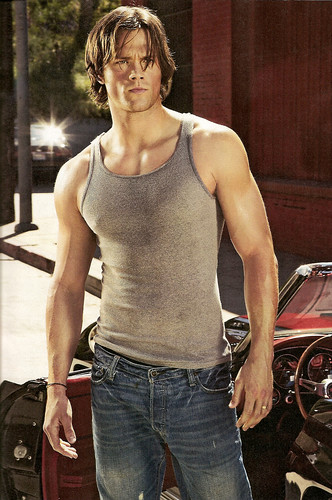


Hopefully I'll get around to watching season 2 of Carnivale sometime this decade.

10 August 2008

I used to be a superhero, I would swoop down and save me from myself

When I started typing this I'd just returned from watching The Dark Knight. There are two things I perpetually love about travelling around a big city by myself:

*Walking around in a pretty dress, high heels and sunglasses in the sunshine at whatever speed I want.
*Cruising around in a cab at night, watching the lights, both of the city and its reflection in the river. If the driver will put up with me murmuring along to The Long and Winding Road so much the better.

I would have preferred to watch the film a little earlier in the day, but it was worth waiting for (and I think it's always nice to come out of watching something slightly creepy into darkness rather than jarring daytime). Obviously it's a good film. Even I can't really dispute that. It was (I'm sorry, I must say it) darker than I've grown to expect from Hollywood films. However I don't think that it really lives up to its hype (although, really, what could?). At least for once I'm actually watching the world's most popular movie close to its release date (it was released this week over here in fact). To give you a frame of reference I think I watched Titanic around five years after it was released, and only under extreme duress (i.e. our teacher threatened me with extreme punishment if I attempted to escape the room).

Watching this film made me feel that I really ought to have rewatched Batman Begins beforehand. I remember really liking it (although in part that may have had something to do with the fact that I was watching it stretched out in a deck chair under the stars on a beach on Ko Phi Phi Don with two of my favourite people), and have a vague recollection of finding Katie Holmes annoying. I thought that I had a relatively good memory of said film, but on reflection it appears that I have a crystal clear image of all of Cillian Murphy's scenes- and very little else. So my first bone to pick with The Dark Knight is why the hell would you put Cillian Murphy in your film if you're only going to tease me the audience with about 30 seconds worth of footage? Uncool.

I can't actually work out what I find so appealing about Cillian Murphy, I don't think that he's actually conventionally attractive (aside from the bright eyes I guess). There's something kind of 'off' about his appearance, and yet he's somehow absofuckinglutely gorgeous. And I do honestly think he's a good actor (...she protests, feebly). Is it possible I have an Irish kink? This would be somewhat surprising considering I seem to be the only person I know who doesn't have a thing for the accent, but it could explain why I like Freebird. And Spires. And das boyfriender. (I'm already aware of my shyboy kink; Cillian Murphy and Jensen Ackles I'm staring looking at you, and your twitchery.)

This isn't only an aesthetic gripe, I really don't understand what the point of his cameo was. If he hadn't appeared in the film at all I would have been a little peeved, but I would definitely have gotten over it because Heath Ledger as the film's primary villain The Joker is, in a word, totallyfuckingawesome. I don't quite understand when the (in my personal opinion, not particularly) pretty boy from 10 Things I Hate About You became an actual actor- a really good one no less. This is why I ought to watch more films, so I can actually pick up on transitions like this. I did think that he was pretty decent in Brokeback Mountain, but I suppose my experience of that was a bit tainted by the fact that whilst I don't think that it's a bad film, it is honestly one of the most over-rated films I've ever seen. I'm annoyed by the fact that I can't find any of the stuff that Ted Casablanca wrote about it (damn stupid website), but I believe I can paraphrase: "Just because it's a film with gay cowboys doesn't make it good, and I'm not going to pretend to love it. Watch Transamerica instead." I have an unabashed love for Ted Casablanca- he may write a gossip column and work for E!, but he's an intelligent, witty man who manages to slip in some brilliant social and political commentary in the most unlikely places.

Heath Ledger gave an amazing performance, and the Joker was pretty much the only character that I really cared about during the film (the rest of them, including Batman, were fairly two-dimensional). I think I would have preferred a 'Joker' film, relegating Batman to a relatively minor role. I liked that we never got to actually understand his back story (although I think that there ought to be at least a third, unaborted, alternative), and I think that his character in this film was wonderfully well constructed. His appearance was great too, the pimpy purple suit was perfect, and the sloppily applied make-up added the impression of madness and eagerness (I also love that the make-up has already become an internet meme, even I've noticed it whilst avidly avoiding anything that looked like it could be a spoiler!). The fact that the Joker didn't mind removing his trademark face paint when it suited him (to gain access to a target), not to mention donning a nurse's outfit and wig, showcased his adaptability, and the fact that he's completely unpredictable and chaotic. Ledger managed to pull off this character in this incredibly creepy and terrifying way, and maintained a real distance from any other portrayal of the character. I, of course, also adored the slight homoerotic tension between the Joker and (the) Batman that the film had going on.

I do think that the Joker was explicitly portrayed as a terrorist-style villain in this film, no more than he and other Batman-verse villains are in other incarnations to be sure- but I think that in today's climate it resonates and I'm almost certain that Nolan was aware of what he was doing. His desire to create (if I can use the word in this sense) anarchic destruction I suppose could be interpreted almost as a form of jihad, but I personally saw it as more in line with something like Max Stirner's anarchism. J pointed out that some of The Joker's "terrorist" style activities really resonate with some of contemporary America's worst fears, such as the 'beheading' style videos of hostages.

In general I really like the direction of the two newest Batman films. Batman is one of my favourite "super"(anti?)heroes anyway (and that's probably a large part of why I enjoy Angel). The fact that he doesn't have any superpowers (thus calling into question his identity as a 'super'hero, the 'hero' part can be dealt with later) just makes him far more identifiable. He isn't an alien; a mutant; the Chosen One- and whilst I think that those ideas and metaphors have been used brilliantly in some cases, Batman just offers an even simpler story-telling vehicle. (I'm almost certain that I'm misquoting someone with this (obvious) assertion, but I can't figure out whom. I even checked out the transcripts from The O.C. but I'm happy to report that my favourite Zach quote is definitely about Superman instead. Perhaps I ought to be more ashamed of my love for the first couple of seasons of that show, but I'm not- Seth has a horse called Captain Oates for heaven's sake! And I'm almost certain that at some point he made a play on the "I may be some time" line, although I can't currently find any proof of it).

Of course he's not exactly the Everyman either, perhaps his superpower is actually his wealth? I do sometimes get the urge to roll my eyes when Bruce/Batman is utilising all his expensive technology and tricks to fight crime. It isn't exactly hard (or, therefore, impressive) to do what he does when you've got the money to do it (which reminds me of Spike's response to being kidnapped by The Initiative, a government-run research outfit experimenting on demons, that he always wondered what would happen if that bitch Buffy got funding). Then again it would be pretty hard to rationalise the suit, vehicles, gadgets etc which are an inherent part of Batman's identity without him being incredibly rich.

I like that these new Batman films have been considering the moral ambiguities embroiled in Batman's vigilante status, he definitely isn't a cut and dried hero (although I think that this point stood perfectly well without various characters ramming it down the audience's collective throat). This is the kind of angle that I really enjoy. Bruce/Batman is heroic in his actions and his choices (and indeed his moral code), but he isn't allowed to play the hero, least of all by himself. I'm not sure that he should be either, he displays a flagrant disrespect for the laws, both of Gotham City and of other countries which isn't necessarily the best way to attempt to eradicate (or even control) crime. Allowing someone, anyone, to stand outside of the law is dangerous and questionable, even if he is acting "for good". At what point are the lines drawn? Whose conception of good ought to be allowed precedence? Whose morals? I liked that these ideas were discussed within the film, and especially liked Dent's reference to the Romans appointing someone to dictate in times of crises. Does the fact that people are willing to accept a dictator in times of trouble make this 'right'? Despite the fact that Batman acts in the interest of Gotham City its residents turn on him, they are wary of his (extralegal) power, and I don't think they're necessarily wrong to feel like that. (Again I'm irritated by what an interesting film Hancock could, and should, have been.) By the end of the film his powers have been severely limited, he's been designated the bad guy, and he's purposely destroyed his sophisticated surveillance equipment. The status quo has, more or less, been restored- for better or for worse.

Of course when you think about it things don't work out too badly for the guy. Alright it sucks that people can't properly appreciate the good that he's done, but I'm sure he's soothed by the fact that he gets to enjoy himself in style as the playboy Bruce Wayne. I would have liked to see the slightly schizophrenic bent to Bruce's construction of Batman's identity explored more. He's right that "the Batman" is an important symbol (and the use of that article is definitely relevant), but hearing someone almost talking about themselves in the third person, referring to a persona they've created (for whatever reason), is a little disturbing. In contrast the Joker seems almost sane (that may in fact be hyperbolic nonsense, but you know what I mean).

I don't want any of this analysis to suggest that I don't absolutely adore the campy 1960s Batman television show by the by. I'm sure that this point must have been made before, but I can't recall ever reading or hearing it (please point me in the direction of anything that has, I'd be really intrigued), I feel that the DC and Marvel comic characters are pretty much the twentieth century equivalent of fairy tales. Of course there are actual twentieth century versions of fairy stories, but they play with already established conventions. Comics (and later their screen adaptations) fulfill the same kinds of functions as fairy tales, not just to entertain but to deal with important contemporary ideas in metaphorical and sometimes fantastical ways. The breadth of meaning in those comics is such that they can inspire something incredibly campy, yet also something dark and creepy. This is just like fairy tales, and I wouldn't have such a problem with sanitised Disneyfied version of classic stories if it was equally easy to get a fix of 'proper' fairy tales full of brutality and horror.

I do feel as if a slight reference to the fact that Rachel was portrayed by a different actress in this film could have been made (even just a snide "wow you look so good these days!") although I suppose it might have been a little too light-hearted for this film. I know that it couldn't really be helped, but having a different actress to the one portraying her in Batman Begins was a little jarring (even if Katie Holmes did annoy me in the role). To be honest I don't think that Maggie Gyllenhaal was excellent casting, she wasn't bad or anything but I would have preferred someone with more presence and, crucially, someone who I think is beautiful. Then again I am an awfully shallow person.

Dent's storyline was also an interesting one (although I can't really accept a Dent character whose first name isn't Arthur, unless it's something amusing like "Axi" or "Resi"), and his eventual transformation into Two-Face echoed the split-personality theme which was definitely an important one in this film. His obsessive coin tossing reminded me of The Dice Man, and although I know that the original Two-Face character was conceived long before 'Luke Rhinehart' was published I think that The Dice Man allows a much more in-depth and interesting perspective on allowing fate to control one's life than this film possibly could. This is why I'm just not a film person! The idea of attempting to retain the 'purity' of Dent's memory was interesting, although I didn't like the undertone that a person can only be a 'proper' hero if they're a blond with a Stan Smith-esque chiselled jaw. I might be shallow, but I don't like films telling me that ugly people are baddies.

That's part of the problem with allowing someone outside of the law all that power, he gets to decide what the official 'truth' will be. That's not a responsibility that anyone ought to have, although of course in real life its shouldered by specific individuals all the time. It reminds me of an excellent play called Embedded which was about, amongst other things, the impact of Leo Strauss' philosophy of multiple truths (and/or noble lies) on the decision-makers of Bush Jr's administration. The noble lie is a consistently used device in the film, Rachel is certainly lying to at least one of the men she claims to love at any one time, and later Albert takes it upon himself to destroy Rachel's letter to Bruce so that he may never learn the truth (if indeed it did contain her 'true' feelings, and not a noble lie...) about her emotions.

It's still a little weird for me to watch Gary Oldman playing a good cop, even though every time I watch Leon I never seem to understand (or recall) the fact that he's a crooked DEA agent and am befuddled for a while. He was a fairly likable character, and so I kept expecting him to turn (or be revealed to be) bad. Therefore I wasn't expecting for him to be revealed to be secretly alive after his shooting. I loved his wife's reaction to this, faking your own death to catch a criminal and not even informing your spouse is something that's just likely to get you slapped. His son's reaction I wasn't expecting however, I thought he'd be more likely to freak out about the 'ghost' next to him. I think that the film would probably have been better (although obviously sadder) if the kid had actually died at the end, and at least it would have saved him the inevitable self-esteem issues. I doubt that his father can properly explain "Batman saved your life, and now we have to hunt him and treat him like a criminal. Nothing personal son" in a way that doesn't sound insane. Personality issues of the future, here we come! Is another sequel being made yet?

Can I just point out that it sucks that Heath Ledger's dead? I mean obviously for him, but now also for me too. So now I'm grouchy. I've discovered that he apparently (officially at least) didn't commit suicide, my belief that he did is either due to the British press or only reading the very early reporting of the news which was later revised by claims that his death was accidental. Perhaps both. If he didn't commit suicide and just died from a random, stupid unintended overdose it's even more bloody annoying. The Joker would absolutely have had to have been in the next film, assuming that there was to be one- is it just me or is Christian Bale starting to look kind of prematurely old? I'm pretty sure that Two-Face isn't dead (his story arc has only just begun) so he could be the major villain in the next film, and there's also a whole host of other rouges to pick from of course.

Incidentally Bernie Mac died recently. What's up with 2008? Sadly death hasn't made him seem any funnier.

I had a terrible feeling by the time The Dark Knight was ending. I was worried that I was going to have to face a worse truth about myself than the fact that I'm not a fourteen year old boy. Am I possibly actually a film person? Say it ain't so! The reason I had to consider this for a moment was that whilst I enjoyed the tone and characters of this film, the plot wasn't all that amazing. Pretty much every twist and turn just seemed painfully obvious (except Gordon not really being dead, and that was only because it was kind of stupid), as if the word 'psych!' was written on the screen in big glowing letters. I didn't need to be told about Dent's double-headed coin, that the Joker had purposely got himself caught, that the 'sick' guy was going to blow up, that the Joker had switched the addresses at which Rachel and Dent were hidden, that the hostages were dressed as the Joker's henchmen... and so forth. The only decent bit of misdirection was the Joker's reveal at the beginning of the film where he impersonated one of his own men.

However, I'm not worried. J assures me that all of those things would have been glaringly blatant to anyone. My reputation remains intact. Therefore I put it to you that The Dark Knight had a relatively stupid plot. Strangely enough I still managed to enjoy it, which speaks to its other strengths. All in all I think that I'd feel happy to recommend this film to people, with the addendum that the plot is flawed (although somehow not all that important) and that, despite the rave reviews, this isn't exactly the greatest film ever made.

I'm intrigued now to see if this (long and windy) post has made any impact on my wordle- a really fun toy which allows you to track what the most used words of any given content are. Here is how mine stood before this post (although I'm not entirely sure if it checked everything or only the most recent page), I couldn't find any information on the FAQs but I assume that it must filter out conjunctions, articles and pronouns. It's extremely interesting to see!

My apparently paltry vocabulary made me wince, but I've consoled myself a little with the idea that perhaps I actually have an excellent and varied vocab, it's just that I don't overuse many words except for the practically unavoidable stock ones. Probably that isn't an accurate portrayal, but let's just let sleeping pups (and lazy puns) lie. I was surprised to see 'awesome' looking so teeny, I thought it was definitely one of my go-to words, and whilst I thought that the B(uffy)-word would be pretty significantly placed I didn't expect it to get quite so large! I can excuse myself slightly by pointing to the fact that it does at least convey two meanings (both the show and the character, and I like that by merely choosing to italicise or not I can easily show which meaning I intend) but really I think that I must speak about it/her even more than I'm aware!

Of course Rand, Atlas and Dagny all made the cut too- which reminds me that I forgot to link to this, which contains absolutely no Atlas Shrugged spoilers but did make me giggle. On the subject of linking I have accidentally discovered two things about Neil Gaiman's blog: verily, it exists and I like it. I've already forgotten how I stumbled across it and it was almost certainly within the last 24 hours. Perhaps I should start getting worried about my premature dementia. I recently also got around to watching the Neverwhere DVD extra of his interview, which was pretty fun, and I'd say worth a looksee if you get a chance.

My brief mentioning of The O.C. also tangenitally relates to (and at least reminded me of) possibly my favourite advert ever. Again I feel obliged to point out that Korean cinema adverts are fantastic (especially the Baby Got Back soju one!), I'm glad that this time around they definitely weren't better than the film though.

ETA: Just one post does indeed impact the wordle. It's such a fun game! I must remember to play with it every so often, and also to crack a thesaurus one of these days (especially since I now know that they're not dinosaurs).

09 August 2008

You're talking a lot, but you're not saying anything

I feel that the people in my life can be divided roughly into two camps.

There's those who appreciate my sarcasm, cynicism and general distaste writ large. For some, it's because they share these characteristics and like to bitch and moan along with me, whereas for others its simply because I make them laugh. Naomi takes a simple delight in the fact that someone as grouchy as me can tolerate her presence.

Then there's the others, the ones who love the fact that I'm apparently incredibly fun and carefree. Betty especially is always telling me that she adores hanging out with me because I don't get stressed out like other people, I just enjoy myself. I can understand where she's coming from, but at the same time it seems pretty strange- given that I don't know all that many people who are as perpetually irritated as me. Maybe my grouchiness is just inherently lovable. (I feel as though Spires has said so at some point. Perhaps I'm making it up though.) It might also be that although I do tend to grump and groan I still manage to get on with life (and enjoying its various pleasures) rather than freaking out, or feeling that I'm entitled to something.

I have a very vivid memory of Betty, visibly drained, almost passed out on the grass of Hippy's
garden. She'd had a hellish couple of (sleepless) weeks and had only just returned to London. Hippy was trying to be helpful, but kept adding to the stress by rehashing the situation from every angle. She'd also offer to do something nice, such as get some wine or give Betty a massage, but then make things even worse by complicating things- fretting about accepting Betty's money towards the wine or fussing about which position she ought to be in for the massage to be most 'effective'. Meanwhile I lazed about on the grass and made cups of herbal tea. Betty thanked me profusely for this support later, and couldn't help feeling bitter towards Hippy.

I was also honestly shocked when Pygmy and her Tone found my ranting about Tiptoe's (thankfully now former) shag-buddy hilarious. He was a complete and utter knob, and I spent a great deal of time expanding on that point. They protested that they'd never seen me so hate-filled towards someone, and that completely blew me away. I spend a good deal of my time embroiled in lengthy diatribes about how almost everyone is a complete waste of oxygen, ranting foully really isn't uncharacteristic of me.

Anyway, I find it a little weird that people seem to see, and like, these two extremes in almost equal measures. Apparently I'm wonderfully bitter, and also fantastically not- instead childlike and happy-go-lucky. I'm sure that most people possess aspects of both these types of traits, but again I think that I'm more of an extreme case. I'm special. (And probably don't have a multiple personality disorder.)

Already I find that I'm appreciated here for these apparently mutually-exclusive personality traits. At Yeouido R and I were drawn to each other because we were both just as cynical as each other, whereas Y found me the funnest person in the world (and S, someone I could imagine whatever the Korean version of on otaku is absolutely adoring, kept asserting that I was incredibly cute). Similarly Jes and 2.0 find my sarcasm and constant exasperation hilarious (and Jes' friend Dunkin' actually described me as 'wry', I think that's a new one), yet people like V laud me for being so free and easy (this also leads to me getting excellent texts such as "ENJOY US LATER" from her- I love broken English).

There is of course a third group of people in my life, they don't quite fall into either of the groups described above. I call them my family. They're all very odd, but essentially wonderful. I got very excited when I discovered that my grandfather, Mannie Brown, is on a sign in South Africa (it seemed to fit rather well with the ancestor worship of Atlas Shrugged which I was still reading when I was sent this picture).


On the subject of family I think that this photo has possibly become my absolute favourite picture ever:


In keeping with the split-personality theme, after a fortnight filled with drunken debauchery (and rather a lot of yummy raw seafood incidentally, including live octopus tentacles yesterday) I stoically refused to go out tonight. I think that I tend to be counted in for whatever the plans are, which I don't mind obviously- it's just that I think in the back of my head I thought that this year might have undertones of 'sensible' and 'grown up' and possibly 'not-just-like-London'. I claimed that I wanted to stay in and read Kerouac just because it sounded so deliciously and awfully pretentious (and no-one called me on it!) but mostly I've been cracking monkey nuts, reading fic (actually about someone reading On The Road eerily) and watching Carnivale. It feels so amazingly decadent.

I think that for all that I'm a social person and a person who does love, and enjoy spending time with, her friends and family, I am at heart a fairly solitary person. I relish the opportunity to spend some time alone, and can't imagine finding it boring. Maybe that's because I don't get the opportunity to spend that much time alone, but I don't think it's just that. I feel that travelling and living by myself are special indulgences, the only time I get frustrated by it are when my life sadly has to intersect with the world around me- when I have to sort out annoying real life bureaucracy or technology I could really do with a Tiptoe or PJ perhaps!

I suppose it's because I'm so taken with myriad forms of distraction. I adore music (and being anal about organising my music collection is actually fun for me), watching really good television shows and films, reading (apparently comics as well now), writing and the smug feeling of having replied to all the emails in my inbox (even though its a never-ending quest of course). I can't imagine getting bored when left to my own devises, although it's entirely possible that I could develop cabin fever, or die of malnutrition.

Probably I'll go out into the big wide world tomorrow, and if J's feeling better go shoe shopping and hopefully see The Dark Knight. It's definitely nice to know a few people, such as her, who aren't complete alcoholics!

04 August 2008

Sin(chon) City

It feels so good to have actually started working in Sinchon! Finally starting to actually settle properly is wonderful, and it's great to be in this really cool, fun area (I'm so lucky to have actually got my first choice of branches anyway, and Sinchon is such a sought after destination). Having to commute from Naksongdae is a little annoying, but that won't be for too much longer at least.

One sad thing is that the fact that I'm moving (to the company housing in Hongdae, which is smack bang in the centre of the student district, as well as being a really cool area in terms of music, bars and clubs) is that I'll be taking someone else's apartment. A lot of the native speaker teachers are leaving pretty soon. The guy I replaced, Law, seemed really fun (and British), and now Jes, 2.0 and Dick are all going to be leaving in quick succession. It really kind of sucks because I get on really well with Jes and 2.0, and although I didn't get to spend much time with Law he seemed like a great guy too. He's actually gone on a motorbike trip (complete with video camera) to Jeju island at the moment, but he's coming back to Seoul soon. Jes is going back to the States for health and family reasons (and taking his ridiculously cute, if overly fond of my crotch, dog Soju with him), but all things being equal he should be back in September. Law and Jes are planning on getting jobs together relatively nearby and 2.0 will probably do a similar thing, plus he's dating our assistant manager, so it's not as if I'll never see them again. The fact that the staff were leaving en masse made me a bit worried (it doesn't really fill you with confidence), but they're mostly leaving just because they can get better paid jobs now that they've got a couple of years experience here under their belts.

Mostly Dick just seems to be following them. Nobody likes him very much. He was so rude to me when I first met him, and Y (who started about a month before me) said he was exactly the same with her, and then he ended up being her partner! To be fair every day since then he's made a lot of effort to be really nice to me, and randomly wrote down my name for me in Hangeul without me asking (it's just a little thing, but it is quite sweet and helpful). I feel a bit sorry for him because I think that he just doesn't really understand how to interact with people properly, but he's just so fucking condescending and smug all the time. It's weird to hear Jes being (relatively) vitriolic about Dick cos he's just one of those incredibly genial, easy going people who gets along with absolutely everyone and never seems to see the bad side in anyone.

The other native speakers, Dar and S, are staying put, at least for the time being!

The partner situation is a bit messed up as a result of all these changes, my partner was K, it's now mostly Clairebear (who sadly doesn't look anything like Hayden Panettiere, cos believe me I'd be all over that), but I think will switch back to K in a couple of weeks when Jes leaves. K is really fun and easy to get on with (actually she spent five years in England, but has carefully cultivated an American accent as it's more popular here- however she always slips when she says the word 'British'). When we go out though she always wants to be the centre of attention, which can be a bit tiring. It isn't hard for her to get attention by any means, she's stunningly gorgeous (she's rejected my marriage proposals so far on the grounds that our difference in ages is too great, but I'll persevere!), poised and an amazing dancer. She put this to great advantage the other night when she tried to get off with (and get drinks off of) two of Jes' friends at the same time. We were all glad that she was keeping Rus away since he's an annoying drunk, but we didn't like the fact that she was messing Scotty about. I normally don't like people who run around screaming "what up dawg?!" but Scotty's a Canadian on a mission to be as obnoxious as possible while claiming to be a citizen of the US. He also wears tartan trousers, cries about his girlfriend in public and offered to sleep on the floor for me. He's awesome.

As for the other Korean teachers, I get on really well with Y and love going out dancing with her (even if she has pretty appalling taste in guys!). Ser is also really fun (and practically has corporate sponsorship from the Korean air industry). Clairebear and Is are both real sweethearts, but they're kind of our resident 'good girls' and can barely finish a beer. I'd love to see the job description for the manager and assistant manager positions. Hans seems to think his job is mostly 'take the staff out for lots of food and booze; force feed the staff a lot of watermelon; fuel the staff's polo addiction; do not enforce any rules whatsoever' and D seems to think her entire job consists of running around in short skirts and patting people good naturedly. It's a great place to work as a result, everything is incredibly chilled. Also because I'm a girl I practically count as one of the Korean teachers so nobody cares what I wear which is excellent.

I haven't had too many lessons lately, partly because a lot of the university students (a large part of our clientele) are off enjoying their summer vacations, and also because I'm the newbie. I've been enjoying the down time, especially because I sometimes really need to have a nap (we have bunk beds!) when the drunkeness, hangovers and sleep-deprivation catch up with me. The joys of work are added to by absolutely awesome reception staff, it sounds like a little thing but it just makes work a lot easier and more fun. Lin was actually my first student in the mock lesson and she can be a bit solemn but she's really nice, V is totally insane but in a great way (and she has the best laugh ever!) and Raf speaks brilliant English which means that everything goes really smoothly (she came with me to set up a bank account, for example). We also have a lot of restaurants which deliver yummy, cheap food- which I appreciate an awful lot when I can't even be bothered to stumble out of the staff room and its comfy beds.

I offer some illustrative pictures filched from others for your delectation:


I wonder if you can tell which one I am? From left to right (excluding me) are Y, V, Lin and Christine (who has now left).


S and I being especially photogenic.


This is Computer Guy after Hans poured an excessive amount of soju into his beer and made him drink it, followed by a few shots for good measure. This is why Hans is an awesome boss.

I'm going to ban myself from writing about books, at least for a little while, I tried to write a short round-up of what I'd been reading in the last month and instead wrote three fairly long entries. Literature makes me long-winded; books make me babble! However, I would like to add one, oh just one, teeny point that I forgot about Atlas Shrugs- I really liked this quote:

"I like to think of fire held in a man's hand. Fire, a dangerous force, tamed at his fingertips. I often wonder about the hours when a man sits alone, watching the smoke of a cigarette, thinking. I wonder what great things have come from such hours. When a man thinks, there is a spot of fire alive in his mind--and it is proper that he should have the burning point of a cigarette as his one expression."
I don't smoke, but I find myself agreeing with the guy from the newsstand here. At least a burning cigarette fits entirely for me with the image of a great man that he's suggesting, probably along with a glass of whiskey. Plus it just makes me think of Tex Williams, and I doubt that that can ever be a bad thing.

Anyway I'm planning on doing a monthly book round-up post from here on out. The Buffy comics don't count as books however, so there may be something incredibly lengthy about them soon.

30 July 2008

Atlast!

So I finally finished Atlas Shrugged. (Although I'm not sure that 'finally' is the word I ought to be using, it only took about a week and a half and I had to fit it in around life, it just feels as if I've been reading it for ages...)

Of course now that I've already babbled about it considerably I'm not sure that I'm going to end up with anything coherent to say about it as a whole. It isn't as if I'm under any obligation to write in any kind of structured way I suppose. It's weird, because when I started university I kind of hated the way that we had to write essays. I especially hated the fact that we had to consider other people's theories in depth, long rants which only considered my thoughts on a topic (with a few throwaway nods to broad schools of thoughts perhaps) that one could get away with at A Level were so much more preferable. Now, however, I seem to have been entirely retrained. Damn degree. I feel as if I should have been annotating my copy of the book, and as if I should now be reading obscure articles about it (although that might not be too easy since my Athens account expired a long time ago).

In all honesty that 'retraining' is probably a good thing in the long run. It pushes me to at least attempt to make relatively informed statements and arguments, in addition to loudly proclaiming my own opinions. Thankfully Spam (with all of the wisdom of his sixteen years) can't reach me all the way in Seoul to earnestly inform me that my opinions are just that, and I shouldn't state them as if they were universal facts since he's off sweltering in the Namibian heat building a school. I am thankful to various teachers, lecturers, writers and friends that I have at least a basic knowledge of political ideology, some philosophy and a fair bit of social science. Most of all I think that I'm indebted to Ian Adams the author of Political Ideology Today, which is honestly one of my favourite books and I could happily read it cover to cover repeatedly. I'm probably going to miss my highlighted copy before this year is through.

I still haven't worked out who the hell Francisco reminded me of, and it's bugging the hell out of me. It was especially strong earlier in the novel when he was in the position of a tempter, luring people to go on strike. Knowing me it'll probably turn out to be a Whedon or Sorkin character, and the cogs of my brain will probably finally find the answer for me to scream out at an utterly inappropriate moment. C'est la vie. I remember that after watching Dune (which I also still haven't read) I had an incredibly strong sense that the Fremen's blue eyes reminded me of... something which I just couldn't quite grasp. I drove our poor lecturer somewhere round the bend as she listed off lots of possibilities, most of which were obscure references to science fiction films or television shows that I have no knowledge of. When I finally worked out that it was Groo (a fairly minor character from Angel), I don't think she considered it to have been worth all of that effort.

John's radio broadcast (apparently around three hours long, which I can well believe- but I didn't mind the length here since it was conceived of as a speech, and so didn't feel false) slightly reminded me of a much shorter speech. Wes Mendell's in the Studio 60 pilot. The first couple of episodes of Studio 60 had me bubbling with excitement, I'm still kind of annoyed at the way it ended up. Here is a link to the clip from the pilot which culminates with said speech (and I'd completely forgotten that Felicity Huffman had a guest spot in the pilot, please she so is Dagny, enough with this Angelina nonsense). I'll also include this link to the cold open from, uh, The Cold Open for no reason other than it makes me laugh.

On the subject of Francisco, which I'm sure that I was discussing at some point, I was immediately convinced that Frank Adams was him as soon as I read the name 'Frank'. I didn't have to wait long for that reveal, but Hank's surprise at something that was so obvious was typical of a lot of the book. Again and again the reader becomes aware of something that a character desperately wants to know or should know, the identity of Eddie Willer's confidante for example. This had the effect of making me a bit exasperated with Hank, Dagny and Eddie time and time again for being so dense (and for their inevitable gasping when they discover the truth) even when, based on the knowledge available to them, they weren't actually being intensely stupid. It reminded me of Harry Potter a little, although I don't think anyone could be quite as dim witted as Harry (or gasp as much as Hermione). Luckily I love the word phrase hyphenate 'self-immolation' (and I'd like to point out that I'm the one who came up with the 'molating Marx thing, and probably plenty of the others even if I can't remember them... firing Foucault possibly?) otherwise I'd definitely be complaining loudly about its overuse.

I very much loved, in a pretty much unqualified way, Rand's attacks on Cartesian duality; the split between mind and body. I'm a bit confused by one aspect of her philosophy though, she seems to like Aristotle (whilst certainly not refraining from criticising him), but I'm sure at some point there was an incredibly disparaging remark about Plato's student and successor. (This is why I should have annotated, I'm never going to be able to find the quote again!) I assume that she meant Aristotle by that, although I suppose she could have just meant that she preferred Plato's philosophy, although I didn't see any evidence to support that.

Personally I feel that there's never been a proper free-market Capitalism experiment, just as there's never been a proper Communist one. Maybe it's because they only really exist as ideal types, and life is a lot more messy, but its certainly (also?) because they haven't been allowed. Dagny (and the others) look towards an idealised past (where Nat Taggart roamed around) of perfect laissez-faire capitalism. I'm pretty sure that that didn't exist. The free market has never truly been free, I'll come back to Benjamin Tucker for example: he argued that the four main monopolies (money, land, tariffs and patents) would need to be broken down first before a truly free market could be set up. We see examples of it all the time, the US government cries that the market ought to be free! Except for pharmaceuticals. Importing cheap Canadian drugs would hurt American producers, and that would be wrong. Repeat ad infinitum with whatever it is this week.

I'm sorry, but I'm coming back to Marx again. I just feel that Rand (and she's certainly not alone) misinterprets his views on Capitalism. He didn't hate it. He didn't want to destroy it. He thought that it was excellent, in a limited way. It unleashed enormous productive power, and allowed for innovation in a way that previous epochs had not. He didn't provide a moral criticism of Capitalism in his work, and he in fact explicitly argues against trying to bring about the untimely end of Capitalism. He simply believed that Capitalism was beset by inherent contradictions (just like the previous socio-economic systems), and as a result would eventually collapse and give way to a new social system.

Needless to say, he wasn't exactly right about how it played out. I'd definitely be interested in finding out if Rand ever explicitly discussed her attitude to Marx's writing. In Atlas Shrugged she doesn't, but I feel (perhaps wrongly) that some of her criticisms are directed that-a-way. There's a lot of stuff in Marx's writing that I think Rand must have agreed with, not least his emphasis on rationality and of course that famous sentence from Theses on Feuerbach, " The philosophers have only interpreted the world, in various ways; the point is to change it".

Of course I suppose that her criticisms were actually directed more at the Russian governement then at their (claimed) ideological underpinnings. It's hard to work out when the novel's supposed to be set, since it's futuristic in some senses but also rapidly retreating into the past. Combined with that is the fact that the characters are often looking to an idealised industrial past, which often permeates their world and time, especially as the setting of the railroad (and to a lesser extent the mines) has a distinctly nineteenth century quality to it. In my head I kind of split the difference and seem to be imagining something vaguely 1930s-esque (I suppose I can partly blame this on Carnivale too). I get the impression that Rand was explicitly critiquing Roosevelt's policies, and I can understand why her ideas would clash with his "make work" philosophy. However, at the same time I can see similarities between his New Deal and the great minds of Atlas Shrugged trying to rebuild the world after its destruction... (Of course it also makes me think of Toby's revulsion at the idea of including "the era of big government is over" in the speech in He Shall From Time to Time in which I don't think the name "Roosevelt" is ever spoken, but I swear that you can actually see what Toby's thinking. I love Richard Schiff a little too much.)

Well maybe the real problem with a university education is it creates the desire to identify fleeting similarities and synthesise ideas?

I also felt that the arguments against the 'mystics of muscle' seemed to be more of an argument against the Functionalist school of thought than anything else (especially with the organic analogy). I suppose Rand wouldn't particularly like them, but it felt a little weird in a rant that seemed mostly against altruism and collectivism. I also wondered if the fact that both John and Ragnar raise the issue of income tax as important was construed as an explicit reference to Thoreau. I'm glad that there was a reference to the fact that paper money is assumed to be worth the same as gold, I think people should pay more attention to the fact that the world's economy is basically held together by a mass delusion. No one's on the gold standard anymore, and there might very well come a time when you don't really care how many flimsy pieces of paper you're holding or how many zeroes are at the the end of the number on the computer screen. Hopefully by then I'll be back in London with my pumpkin patch and fruit trees though, so I won't really care.

I would have liked to see religion addressed more. Rand dismisses religion (and I personally don't have a problem with that), but it wasn't really dealt with much within the novel, there weren't really any religious characters. After reading the introduction I'm a tad annoyed that the Father Amadeus character was cut, but I might have had to spend some time trying to work out where his name fits on the awful/awesome axis if he hadn't been.

Rand belittles the sociological/interpretivist-style criticisms of science. I will freely admit that sometimes these criticisms can be take way too far. I love Bruno Latour, he has an immense and respectful appreciation of science and he acknowledges that there are such things as objective facts. However, he points out that science in the process of occurring isn't a series of objective facts, and argues that stating this isn't a rejection of science. I'd also like to add that Rand actually endorses one of those criticisms of science without acknowledging it, she's disgusted by the idea of state funded science, and that's something which many of the sociological criticisms of science have highlighted, as well as investigating other ways in which the production of scientific knowledge is effected by other (subtler) factors.

The book definitely contained far too much of an Orientalist attitude, an extreme overuse of the word 'savage' and an apparent damning of everything 'non-American'. I don't have a problem with the novel's pro-American sentiment (nor do I have a problem with it in anything penned by Aaron Sorkin), even if I don't endorse it. I do appreciate passionate feeling like that, and basically anyone who subscribes to the Granny Weatherwax school of philosophy:

"...well, you wouldn't catch me sayin' things like "There are two sides to every question," and "We must respect other people's beliefs." You wouldn't find me just being gen'rally nice in the hope that it'd all turn out right in the end, not if that flame was burning in me like an unforgivin' sword."


I know that Rand's views on race and gender (and other things too of course) are a product of her time. I expect some things to crop up that I dislike but can understand as a result of this. I think it's just a bit too much though. I have to contend that in some areas she was just a bit of an idiot, and I'd be interested in reading Feminist Interpretations of Ayn Rand, especially Brownmiller's 'Ayn Rand: A Traitor to her Own Sex'. I assume that that title is there for shock value, at least to some extent, and that there is some appreciation of Dagny's character (and indeed Cherryl's, although it would have been nice to see her develop a bit more before her death). I assume that there's plenty of criticism of the (relatively?) sexually submissive role that Dagny randomly gets cast in, which I'd definitely be interested to read.

I've never understood why someone would think that I would want my cake if I wasn't going to eat it too. Claiming that one can't eat one's cake and have it too at least makes sense.

It's a good thing that John was the one who started the movement, if people were wandering about asking who Francisco D'Anconia or Ragnar Danneskjold were all the time the book might have been a lot shorter. Certainly it might have taken the government a lot less time to track John down at the end if he didn't have such a common name. I felt worried that things were going to take a tragic turn when Dagny led them to John, and I'm glad that instead there was a happy, hopeful ending. (And that Dagny wasn't punished for being a silly, emotional woman.) I felt kind of sad for poor Eddie though. I liked the idea of the torture machine- it was really gruesome (and the idiots torturing Galt almost to the point of death because they were adamant that he had to help them were captivating), the machine itself kind of reminded me of the torture device in The Princess Bride. The idea of trying to torture someone with the sound of their own heartbeat was effective, and it reminded me of the horror that one of Doc Benton's victims in the Supernatural episode Time is on my Side who has a heart rate monitor still attached to him from when he was jogging suffered.

The idea that it's impossible for the nasty bad guy politicians to step aside at the right time idly made me think of F.W. de Clerk.

I know that it's silly, but I think I would have liked a bit more science. I know that Ayn Rand wasn't a scientist. Partly it's just because the refractor rays made me roll my eyes and laugh out loud. It felt like an episode of Johnny Quest, especially with the whole Shambhala feel to Galt's Gulch! I would have loved some science geekery (even if it was complete and utter nonsense) to provide a bit more of an explanation to Galt's super awesome motor, rather than the constant solemn assurance that it was something amazing that would have made the world better, without details to flesh it out and make it sound more realistic.

I think I've come round to the idea of Rand the novelist more. When I first started reading I thought that I was reading a novel designed as propaganda of, or at least promotion of, a specific view point. On completion I can say that it does (mostly) feel like a novel. I've also become convinced that she wasn't engaging with philosophical or political theory (other than her own anyway) as much as I thought she would.

Sadly there was no orgy finale. There was a mention of orgies towards the end, but they're discussed in a very disparaging way. I can at least console myself with the not stated (but clearly implicit assumption) that Hank and Francisco were walking off into the world together. Obviously.

I didn't clock that Ayn Rand was Russian until I read the biographical information in the reader's guide. I guess that explains some of her anger a little bit. It makes sense that Rand wasn't her real name, I think it would be too much of a coincidence if her surname actually was a currency! I'd kind of had her pegged as a Catholic what with all the emphasis on guilt. I should have paid more attention to The First Wives Club where Brenda explains that she's half-Catholic, but that its the Jews that really own guilt. Unless that was actually in another book, which is possible. My brain is addled. Maybe that's why I think that there should be a cartoon of Atlas' shrug (as in the item of clothing). That logically seems like one of those things that only sleep-deprivation makes funny.

29 July 2008

A little more Shrugging

Oh dear. On inspection I discovered that my incredibly verbose last post failed to include the thing that I'd found most irksome about Atlas Shrugged. Namely that it's based on a very bad analogy, Atlas held up the sky, not the world. It's just such a glaring error. I sincerely doubt that no one's written about it! I really need to hurry up and finish reading the damn book (silly colleagues, food and youtube distracting me from my goals) so I can read the introduction and afterword, and then give in to my urge to google...

I know I said that I didn't want to write too much about the book until I finished it, but I think that I might as well express these thoughts as they occur to me before I forget them. Consider them to be first reactions, and open to extensive revisions in the future!

Firstly, I'd just like to point out that Dagny Taggart is an awful, awful name. Who would call their child that? It's so ugly! Tinky Holloway, however, is an excellent name. This is a point I don't think I'm going to need to revise. Also I think it is possible for a book's characters to overuse the phrase "I know it", especially if they insist on constantly doing it grimly.

More seriously, as I've continued with my reading I've noticed less of the submitting woman syndrome, and a bit more balance. I sincerely hope that this trend continues. Even if it does, I'd still like the earlier behaviour to be considered and questioned by Dagny. I like the fact that she sometimes gets to dress up and revel in her femininity, and have that not be separate from her identity as an executive. However, I think that this is slightly tainted by the fact that most of the time she's wearing a nice dress she ends up in some protracted romantic situation. On the subject of Dagny's clothing, I absolutely could not take John's confession of love (and stalking watching over her) seriously, because telling her that he spent the past twelve years watching her from the tunnels below and could sculpt her legs from memory made it sound a lot like he had a fetish for upskirt peeping. That sort of thing can get you fired here you know.

I complained about Rand glossing over large parts of American history. There at least was a reference to Manhattan being sold by the indigenous people for a small sum in glass beads. I could have done without the 'stupid savages' implication. (And anyway, it's not as if that story is supported by any actual facts).

Something that I find kind of jarring (and certainly not just in this book) is that the characters are more wordy than season 7's speech-happy General Buffy. They often give speeches, and I don't have a problem with that if they're supposed to be giving speeches. A fair bit of the time though, they aren't. I don't think it's reasonable for there to be quite so many multi-page monologues. It's a common literary device, but I tend to find it incredibly annoying. That, combined with the fact that they all seem to have an amazing ability to recall pretty much anything that anyone has ever said to them and quote it verbatim and the fact that several of the characters have definite Marty-Lou characteristics and are just too perfect kind of encapsulates what worries me about reading a novel which has a politico-philosophical agenda. The characters are sometimes sacrificed to the author's greater plan and it means that they don't always ring true.

I don't want to give the impression that I'm pissing all over the book though. I'm not, at all. I'm still definitely enjoying it. I wouldn't bother to consider all of this if I wasn't. I like the way that it lightly picks at the flaws of what it criticises, I especially liked this:

There, he thought, was the final abortion of the creed of collective interdependence, the creed of non-identity, non-property, non-fact: the belief that the moral stature of one is at the mercy of the action of another.
I've also thought about it a bit, and I know that a lot of Marx's writing that has what I would characterise as a more individualist bent, and focuses more on ideas of freedom might not have surfaced (or if it had then might not have been widely known) when Atlas Shrugged was written (it was first published in 1957). I also found this Popper quote to be appropriate:

Marx tried, and although he erred in his main doctrines, he did not try in vain. He opened and sharpened our eyes in many ways. A return to pre-Marxian social science is inconceivable. All modern writers are indebted to Marx, even if they do not know it. This is especially true of those who disagree with his doctrines.
The rest of what I have to say is motivated by mere idle curiosity. Firstly, I'm just intrigued as to whether Midas Mulligan ever explains why the Atlantis valley wasn't on any maps? Did I miss something?

Secondly, does "Piss" Harry King in the Discworld books remind anyone of Hank Rearden a little? Or am I just reaching... He is listed on the television trope page for the self made man (which is interesting because I don't think that he's ever been portrayed on television) but I'll take it as evidence that I'm right, even though it isn't that at all.

I'm glad that I'm reading the book in conjunction with (slowly, slowly) watching Carnivale. They're set to similar backdrops so it's nice to have them both captivating my imagination at the same time. There was an awesome quote from Dolan, which for some reason I can't find, about him wanting to help Iris to find her brother so that he can gain a larger audience and get richer. It sounded like something that could have come straight out of Atlas Shrugged.

I'm loving a lot of the Carnivale script in fact. "One of my titties is bigger than the other" is one of the best chat-up lines ever (I don't think it does surpass "You got a raisin? Well how about a date then!" though) and I feel that more people ought to use "percolated" as a synonym for horny.

[Oh, words, words, words... I'm so sick of enamoured by words, (even though) I get words all day through!]

27 July 2008

Um, I gotta book...

^ That's one Buffy line that I've never actually been too sure of... either she means that she has to go sort out her library issues (which is plausible) or it's valley girl for 'go'. According to Stephen Fry 'book' has become textspeak for 'cool', since the young folk are too lazy to deal with the errors of predictive texting.

'Book' was also the name of one of my favourite Firefly characters. Maybe I should just say that he was one of the characters, since I can't really think of anyone on Firefly who wasn't one of my favourites, including the SpJew.

Anyway, I felt like doing a round-up post about what I've been reading in the last month or so.

I'll start with the book I was reading up to my flight out, Scenes of Clerical Life by George Eliot. I'd actually read it before, but years ago and I couldn't really remember much of it. My ailing memory is a bit of a problem! There's quite a lot of classics that I feel that way about, plus I don't think that I fully appreciated what was going on when I read them as a tween, like with Tess of the D'Urbervilles. I added a few books like this that I thought were in need of a re-read to my 'to read' shelf, and I'd just happened to have got up to Scenes by the time I was leaving. I had intended to bring the next few with me, which I think included Gone With the Wind, but due to my incredibly overweight bag I had to leave them behind. The package that my mother attempted to send to me included them I think, but it was intercepted because of the deodorant and she's waiting for me to have a settled abode before she makes a second attempt.

Scenes of Clerical Life is basically a collection of three, very slightly related, short stories. I have a bit of a love/hate relationship with short stories. I think that in the right hands (such as the paws of Daphne du Maurier, Roald Dahl, Philip K Dick or Andrew Davies, and if I can include novellas like St Mawr and The Virgin and the Gypsy in my definition of 'a short story' then I'd like to add DH Lawrence to that list) they can be excellent, and provide satisfying 'bite size' fiction. However, I've experienced quite a lot of fairly rubbish short stories that just make me feel as if I'm wasting my time. I think it can be quite hard for something so short to draw you in and actually make you interested in what's happening. I definitely prefer reading a load of short stories by one author together rather than a collection of tales from different writers (even if they are on a similar theme) because you at least become acclimatised to the author's rhythm and style. Also sometimes you get those nice links between the stories which just gives you a little something extra and makes it feel as if the stories are more than just these 'shorts'. I like that kind of thing anyway, the subtle nod to the careful reader- like in Sharon Creech's teenage fiction for example, all her books (or at least the ones that I read) have a different female protagonist, but they're all somehow linked together even if they don't know it, and there's a small mention of one of them in each book (perhaps the heroine's aunt mentions a girl she might get on with, for example).

As far as short stories go I found Scenes to be a good collection. I suppose it helped that they weren't particularly short either, they felt meaty enough. The first two stories, 'The Sad Fortunes of the Reverend Amos Barton' and Mr Gilful's Love Story' were both fairly enjoyable and showcased Eliot's wit and storytelling ability. Whilst they were often funny, they did both have sad (and kind of abrupt) endings. The third and final part, 'Janet's Repentance' is much, much darker, being about an alcoholic, abused wife. It isn't really a subject matter that lends itself to humour, but then again Juno was an excellent comedy about teenage pregnancy. I certainly thought that 'Janet's Repentance' was well written and touching, but I found certain parts of it a bit hard to swallow- namely the emphasis on how to be (and how one should be) a dutiful wife. Overall I didn't feel that this book was necessarily a masterpiece, but nor did I expect it to be- I think that it's an especially accessible 'in' to Eliot's work and I'm glad that I took the time to re-read it. I certainly want to re-read The Mill on the Floss (I couldn't find my copy at home anyway but I'm sure I can buy one out here) and maybe eventually actually get around to reading Adam Bede!

I don't think I need to say too much about my experience of reading Everything is Illuminated for the second time since I've already babbled a fair bit about it. Suffice to say that I obviously enjoyed it immensely again, and it still managed to make me sob like a small child. I came away from it with the sense that maybe it wasn't the slice of perfection I had thought when I first read it though, and that sometimes the ever-so-postmodern literary techniques were a little bit forced. Wikipedia tells me that I'm not the only one who feels like this by a long shot (scroll down to the 'Criticism' section), so I don't feel like a traitor! I'd quite like to get around to reading The Time Traveller's Wife as well to compare how that feels the second time around, as it (like Everything is Illuminated) is a book that I read fairly recently and was just utterly in love with. Both were initally lent to me by Spires incidentally, who generally has good taste in books, although I wasn't overly enamoured with The Consolations of Philosophy or The Aquariums of Pyongyang.

The next book I got around to reading was Stardust, my going away present from Naomi. I'd already watched the film, which is a bad, bad way to go around doing things and I heartily disapprove of myself for it. I preferred the book to the film, although I still think that the film is definitely enjoyable and actually rather different from the book (I rewatched it on Sunday in a DVD-bang while scoffing down tasty ice cream, and it was an excellent hangover cure). Neil Gaiman is an author that I've always known I'd adore and yet I haven't read all that much by him; I read Coraline several years ago which was enjoyable enough and had some excellent one-liners, but it is a book aimed at a younger audience and I adore Good Omens which he co-wrote with my beloved Terry Pratchett. I've also watched the entirety of Neverwhere which is excellent and comes highly recommended from me (and it's alright to watch that before reading it, which I will get around to one day, since it was a television show first so ha) even though it does of course look incredibly dated. I'm really glad that I read (and watched) Stardust, and hopefully it will encourage me to read more Gaiman stuff. It was just a really fun and whimsical book, and I'm very glad that it wasn't just a cut and dry fairy tale with a happy ending, and even though it isn't a major detail I really liked that Tristan's mother wasn't particularly motherly and was instead kind of harsh, proud and cunning.

After that I got into my first batch of book binges (from the seven storey Tesco's bookshop), starting with The Picture of Dorian Gray. I enjoyed it and I'm glad that I've finally read it, it was certainly fun to find so many Wilde-isms in their original habitat. I feel a little weird that so many of his characters' sayings get attributed to him as a person, obviously they originate from him and often they may very well express his feelings entirely (possibly proven by the fact that he recycled them and put them in the mouths of other characters), I just feel that when people are quoting his characters they ought to at least parenthetically point that out! Reading Dorian Gray was a little uncomfortable for me because although Lord Henry is the obvious avatar of Wilde, I think there was also a lot of him in Basil, and it's so sad to read about Basil's obsession with Dorian, and feel how eerily it foreshadows Wilde's own devastating love for Bosie. I could not help myself from imagining Dorian as looking an awful lot like Jude Law playing Bosie in Wilde as a result. The actual story of Dorian Gray is fairly simplistic (and I wasn't aware of just how common it was at the time) but it's a very well-written and well-executed book. I liked the insights provided by the introduction in my copy (although I really think that these analytical introductions ought to be shunted to the end of the book because I never read them first since I don't want to be spoiled!), although I think that counting the amount of times the word "wild" was used and trying to use that as evidence of Wilde's egotism was stretching things a little far.

My copy also included some very well-written short stories, in fact I think I'd be happy to add Oscar Wilde to my list of favourite short-story authors! 'The Happy Prince' was a sweet tale (although I felt a slight objection the almost jarring religious twist at the end), 'The Birthday of the Infanta' was enjoyable with a sudden twist at the end, and 'Lord Arthur Savile's Crime' was brilliant and darkly hilarious. I'd definitely recommend checking out some of his lesser known shorter works like these to anyone who likes short stories and/or his better known stuff, and I would certainly like to read more of his fairy tales.

Next I (finally!) read The Catcher in the Rye. I guess it's one of those books that everyone feels that they ought to read, but I've never acted on that impulse (probably because I never found a copy of it in the house). I kind of wish that I had done, because I feel that if I'd read it at the right time in my life I might have enjoyed it a lot more, as it was I could see its merits but it just didn't do much for me. I can't personally really understand why people rave about it. It isn't a bad book at all and it did have some amusing observations but it just wasn't saying anything particularly earth shattering. It does an excellent job of capturing an annoyed teenager's voice, but that isn't enough to make it amazing, and quite frankly it isn't the most interesting point of view in the world (unless we're talking about Gossip Girl, natch). I think that I have a bit of bias against fiction written in the first person as well, which probably doesn't help. The fact that I was a little underwhelmed by The Catcher in the Rye has led me to accept a difficult truth about myself that I'm finding a little hard to cope with: I am not a fourteen year old boy. It's pretty sad.

Although The Great Gatsby was also written in the first person, I enjoyed it a lot more than The Catcher in the Rye. I've always had a complete misconception about The Great Gatsby, I think it's because I read a (much longer) book as a kid called 'The Great...' something, maybe it was 'The Great Grey'? I'm fairly certain that it was alliterative. So they've sort of been vaguely connected in my psyche, giving me the impression that The Great Gatsby had something to do with chases, and possibly mystical creatures of some kind. Those impressions have now been properly debunked and I'm happy to announce that I think it's a great, and tragic, book. It's a very touching story, and Nick makes an excellent dry, detached narrator. My interest in J2 AU fic began at about the same time as I was reading this, and it was kind of weird that I was reading this at the same time (please be warned that there's an awful lot of gay sex, drugs, meanness and prostitution if you click on that link), which although completely different from The Great Gatsby had one very similar element: the idea of a person being completely besotted with someone, and holding on to that for so long instead of moving on. I often find that when I become interested in something, such as a book, I find similarities with it everywhere though, and I'm sure that that happens to other people too.

My trio of first person novels was completed by The Curious Incident of the Dog in the Night-time, and I definitely feel that it's a form that I could do without reading for a little while. Like The Catcher in the Rye, I feel that this book is a little overrated. It is an interesting view point and I think that mostly Mark Haddon writes well, but (again like The Catcher in the Rye) it feels a little 'light' and fluffy, it kind of reminded me of Tuesdays with Morrie as well. I think that it's lazy writing to just create a scenario where your audience is going to feel sympathy for your character/s, I want something more, I don't know how to define what exactly it is but it makes a book resonate 'deeply'. I also felt a bit weird about Haddon's choice to write from the point of view of an autistic boy (especially as it isn't actually explained in the book that he is autistic, unless you count the blurb), whilst I suppose that it is awareness raising I felt as if he was somewhat exploiting his first hand experience of working with autistic people. I'd really love to force my parents to read this book and get their impressions of it, since they both have experience of working with autistic children (my mother mostly with very young children and my father more with teens). I also felt that the ending wasn't very satisfying. Overall I thought that it was an interesting and ambitious idea for a book, but it just wasn't something amazing and not really my type of book, though I can appreciate what other people find likable about it without completely judging them.

I did however feel rather let down when I read Dead Poets Society. Being as I'm not much of a film person it shouldn't come as too much of a surprise that I've never actually seen the film, so when I saw the book I figured that it would be a great idea to read it. Too late I discovered that the film isn't based on the book, but the other way around- the book is inspired by the film. When I realised that I didn't expect it to be particularly great, even so I wasn't expecting it to be so bad. It's especially irritating because it could be good, yet doesn't deliver. I'd still be interested in watching the film because I can imagine a lot of the ideas that don't quite work in the book being realised successfully on screen, and it's a little annoying that if and when I do watch it I'm already going to know exactly what's going to happen! I'm kind of pissed at this book for not being good enough to like, since it does have elements which I really could enjoy- I like passion for writing, and I really like Walt Whitman! It probably doesn't help that I'm not the biggest fan of poetry though. I certainly think that if this book were fleshed out more and didn't feel quite so rushed it might be more enjoyable, and I'd definitely veto idiotic teenage boys claiming they're in love with a girl after meeting her for about 30 seconds, along with idiotic teenage boys running around a cave whooping 'like savages' if I'd been in charge. I suppose I really must come to the conclusion that I'm definitely not a teenage boy, and just stick to reading smutty school boy fic.

Once I'd finished that book I began with the spoils of my Kyobo trip. The Kyobo book store is really awesome, and huuuge- although the English language section obviously doesn't take up the majority of the store. It was still pretty sizable and impressive though. I've started with Atlas Shrugged and from the looks of things I might be reading it for a while, it's over a thousand pages and I'm only about three quarters of the way through. To be fair though I haven't really been reading it much at home, mostly just when I'm on the train (which is kind of funny because while it isn't actually about trains, a lot of the time it's about trains) or sometimes when there's been a lull at work. It's a pretty long book though, about equivalent to The Lord of the Rings, and that's kind of a trilogy, even if it isn't supposed to be read separately, and anyway that's stuffed full of appendices which fill up a lot of the pages. I don't have a problem with it being long, but I wish it wasn't so bloody big, it takes up most of my handbag all by itself!

I don't want to write too much about it, because I've resolved to reserve judgement until I've actually finished it, plus I haven't really researched (or even wikipedia'd) because I really don't want to be spoiled, but I'm just going to share my impressions so far. First off, I like it. More than I thought I would, if I'm honest. Mostly I think that it's well-written (although there's the odd sentence that makes me roll my eyes and wish it had been better edited...and the mere fact of the book's length makes me think that an editor could definitely have been useful) and very thoughtful. It consists of well constructed arguments, and it demands that you think out your objections and counter-arguments carefully rather than going with an vague, intuitive feeling about something. I don't think that I necessarily agree with Rand's arguments, but that doesn't matter. It's nice to just read and consider well argued theory. I do feel a little weird about the fact that I'm reading fiction (that isn't simply an allegory or a satire) that seems to have been explicitly created, at least in part, to promote an ideology but I also know that if that doctrine sat further to the left I'd probably find it a little easier to swallow, so I probably shouldn't complain about it.

I certainly feel that it's often less of a defence of selfishness than it thinks it is. Maybe that's just my personal interpretation because I think that 'selfishness' still has a negative gloss to it, in the way that a defence of egotism or self-interest probably wouldn't to me. Even so, I don't really buy the idea that these characters are necessarily all that selfish. They're well rounded composite characters rather than caricatures, which is definitely a good thing, but they're also just incredibly noble most of the time. They demonstrate time and time again that they subscribe to a higher morality, to certain ideas of what is inherently right- and it doesn't just happen as a by-product of their selfishness at all.

I'm glad that the novel doesn't hide from just how American it is, although I would like it to at least acknowledge that this 'selfishness' that it lauds is a value (if indeed it is one) which applies uniquely to a very specific context. I think the idea that Capitalism arose in the States as a rejection of the idea of slavery is an interesting one (merely mentioned as a throwaway comment thus far, but I'd love to see it expanded on), but I'd also like the book to maybe at least touch on America's history of genocide and slavery. I think it paints a very skewed version of American history, not only in largely omitting these very obvious points, but also comitting the common sin of completely ignoring the importance of collectivist ideas, and yes even socialist ones, on the early history of the USA.

It does definitely strike a chord with me. It has these beautiful ideals, which I can appreciate even if I don't necessarily agree with. I started off rolling my eyes a little at the ideas it was presenting. I was thinking "sure, I'd love to go and live in a wood cabin (with wireless) and ignore everyone", but I didn't think that the book was going to actually create this awesome enclave (hidden by some hilarious comic book style technology) where the 'deserters' could live happily apart from the rest of the world. The plot is doing nothing less than embodying everything wonderful about anarchism, and crucially it isn't only the (primarily American) individualist strand (embodied by Thoreau) but definitely also contains ideas that resonate with Proudhon's, Tolstoy's and even the good parts of syndicalism.

The abject hatred towards Marxism (and indeed the word 'contradiction'!) expressed in the book makes me a little sad. I don't think that Rand's vibrant support of the free market is necessarily entirely at odds with socialism, especially that of a strongly anarchist bent- like Benjamin Tucker's theories for example. Obviously I can understand Rand's outrage and disgust at the way she saw 'Communism' being implemented in her life time, but I don't think that that should lead to an outright dismissal of Marx. I think that their theories have some common ground, he too wanted the best of the best! In fact I can imagine Karl Marx as actually fitting in quite well with a lot of her characters (although I don't think she would have liked Engels very much)...

I definitely have some problems with the way that she writes about women. Dagny is a very strong and likable female character (who clearly looks an awful lot like Felicity Huffman in the Sports Night days, she even dresses like her) but I really hate a lot of her romantic and sexual relationships. Although Rand creates an eloquent defence of pleasure seeking, arguing against allowing sex to be tainted by guilt, I can't stand the way Dagny is constantly submitting and giving herself to be 'used' by her lovers. Sometimes the male characters seem to be submitting too, but it is to passion, rather than to a woman. I find it to be incredibly grating. Also, the most 'evil' character book appears to be Dagny's opposite, Hank's wife Lilian (I'm not entirely convinced that the 'Lil-' name is unintentional either). She's definitely a despicable person, but I'm not sure that she deserves to be painted as the absolute worst character in the book simply because she's "not-Dagny". I hope at least that the motives for her behaviour are explored.

Earlier I felt that part of the novel was basically a love story between Francisco and Hank, now it feels more like one between Francisco and John. I suppose I can just hold out hope that the free love angle gets pursued, and that there's a better orgy than in the Perfume movie (the one in the book was just dandy) in the offing. I also desperately need some respite from the fact that no less than four of the main characters are now in love with Dagny, and I wouldn't be entirely surprised if that toll grew a little. I don't know if this is a brand of Mary Sue-ism, but it's certainly irritating.

I so knew that as soon as I claimed I wasn't going to write much about this book right now I was doomed to fail. I'll probably write more when I've finished it.


I've also been entertaining myself with this awesome blog which allows you to read comics online. I'm not all that much of a comic fan, although I really adore X-Men for example, I'm much more au fait with the cartoon than the actual comics (and also the first two films which were great, and check out this fantastic review for some of the reasons I hated the third one). Even though I obviously utterly adore all things Whedonesque, I've never actually read any of the Buffy, Angel or Firefly comics, or even Astonishing X-Men. Even when I found out that Joss himself was taking them helm for a Buffy season 8 in comic form I debated whether I wanted to get invested. Silly, silly me. Scroll down to the bottom of this page if you want to check out season 8, which I do recommend doing (although I've only just started episode 5 myself).

I was also giggling at the woobie trope post. I especially loved that for both Buffy and Supernatural a blanket statement was needed to explain how much trauma pretty much all the characters face. I really don't understand how Mulder didn't make the cut though, there's a boy who seems like he could really use a hug.

A fairly tenuous leap (which might make a smidge more sense in a sec) brings me to something that I've been pondering: is there a term for a love of Jews? Cos if there isn't, can I please suggest that the word Semiphilia needs to come into effect, like now? Especially so I can describe Kristin Chenowith as a Semiphiliac. This picspam goes a way to proving it, if her love of Aaron Sorkin wasn't enough to do that anyway. (Did you know that they're back together? Maybe his overly-revealing, highly disturbing analysis of their relationship and subsequent break up as portrayed by Matt and Harriet in Studio 60 somehow won her back, or maybe she agreed to give him another chance if he swore to never, ever do something like that again. Who knows.) The picspam mentions a lot of the reasons why I adore Kristin Chenowith, but I figure that they can handle being restated a few times: she was Glinda (and that's just awesome), she's great in Pushing Daisies, she somehow wasn't annoying in The West Wing even though she should have been, it is almost impossible to believe that her and Allison Janney are the same species and, yes, her breasts. Since David Duchovny somehow managed to make his way into said picspam (for reasons that I don't entirely understand), I'm prompted to ask if there's such a thing as Demisemiphilia? Can I be in charge of all the words now please world?

Blog Archive